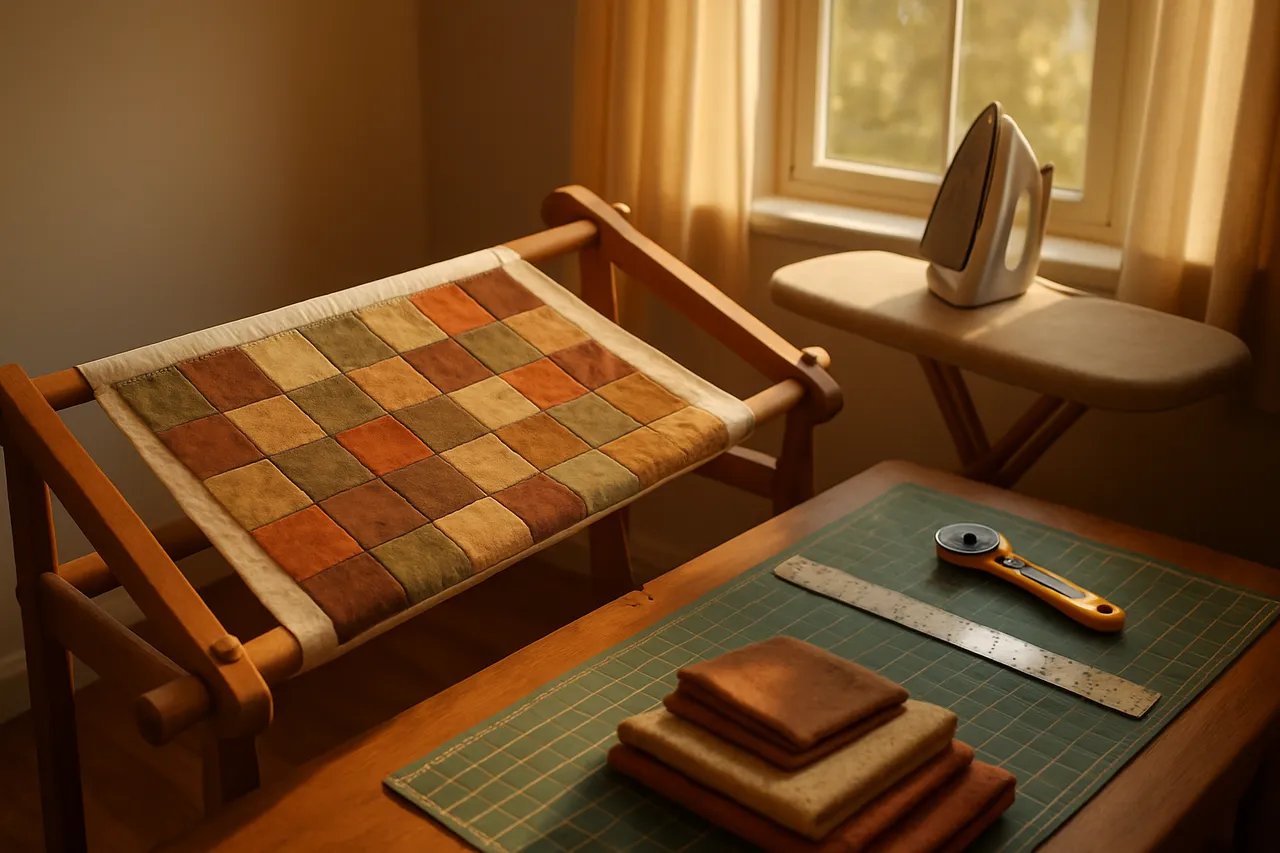
Hand Quilting Fundamentals
You'll leave this class with a hand-quilted table runner you actually made yourself, start to finish, no sewing machine involved. We start with the boring-but-important stuff: how to cut a straight square, why grain matters, and how to press without wrecking your fabric. Then you'll piece a simple block and hand quilt it with a hoop and a size 9 needle.
This is for beginners. If you've never touched a rotary cutter, you're in the right room. If you want machine quilting, I'm the wrong instructor and I'll tell you so.
Hand work suits real life. You can pick it up and put it down in two-minute chunks. Bring your hands and some patience for ripping out. We meet Mondays, 1 to 3.
What you'll learn
- Cut and square fabric accurately with a rotary cutter
- Sew a straight quarter-inch seam by hand
- Assemble a quilt sandwich and baste it securely
- Hand quilt even stitches using a hoop and needle
- Bury knots and bind edges for a finished quilt
Materials & tools
What to bring
- Quilting-weight 100% cotton fabric — 3-4 fat quarters in a few colors that read well together ($2-4 each; a "fat quarter bundle" runs $12-25)
- Cotton batting — a crib-size piece (roughly 45" x 60") is plenty for a table runner ($8-14)
- Rotary cutter, 45mm — the standard size for cutting straight strips and squares ($12-18); keep the blade capped when not in use
- Self-healing cutting mat, 18" x 24" — needed under the rotary cutter ($15-25)
- Acrylic quilting ruler, about 6" x 24" — for measuring and guiding straight cuts ($15-25)
- Hand quilting "betweens" needles, size 9 (a size 8-10 assorted pack is fine) — short needles made for the rocking stitch ($4-7)
- Hand quilting thread — a coated cotton thread made specifically for quilting, one neutral spool ($4-6)
- 14" wooden or plastic quilting hoop — holds the layers taut while you stitch ($10-20)
- Thimble that fits your sewing-hand middle finger — metal or leather ($3-8)
- Small sharp scissors or snips for trimming thread ($5-10)
Nice to have
- Curved safety/basting pins, size 1 — for pin-basting the layers before quilting ($6-10 for a box)
- Fabric marking tool — a hera marker, chalk pencil, or water-soluble pen for drawing stitch lines ($4-8)
- Seam ripper — for the inevitable ripping-out ($3-5)
Lessons
- Gathering tools and setting up your space
The gear you actually need and how to set up a safe cutting station.
- Choosing and preparing your fabric
Picking fabric, understanding grain, prewashing, and squaring up before you cut.
- Measuring, marking, and cutting your pieces
Marking squares and making clean, consistent cuts with the rotary cutter.
- Piecing the top by hand
Hand-sewing quarter-inch seams, pressing, and joining pieces into a block.
- Layering, basting, and the quilting stitch
Building the quilt sandwich and working an even hand-quilting stitch in the hoop.
- Binding and finishing off
Burying knots, binding the edges, and giving your runner a final press.
Key terms
- Quilt sandwich
- The three stacked layers of a quilt — the top, the batting in the middle, and the backing — held together by the quilting stitches.
- Quilt top
- The decorative front layer, usually made by sewing smaller pieces of fabric together into a design.
- Batting
- The soft middle layer (often cotton or polyester) that gives a quilt its warmth and loft.
- Backing
- The single piece of fabric that forms the underside of the quilt.
- Piecing
- Sewing cut fabric shapes together to build the quilt top, one seam at a time.
- Basting
- Temporarily holding the three layers together with pins, thread, or spray so they don't shift while you quilt.
- Running stitch
- The simple in-and-out stitch, evenly spaced, that forms the actual hand-quilting line through all three layers.
- Rocking stitch
- The hand-quilting motion of rocking the needle up and down with a thimble to load several small stitches before pulling the thread through.
- Betweens
- Short, sturdy needles designed for hand quilting; higher numbers (like 9 or 10) mean shorter, finer needles.
- Grain
- The direction of the threads woven into fabric; cutting on-grain keeps pieces from stretching out of shape.
- Seam allowance
- The strip of fabric between the stitching line and the raw edge, kept at a consistent 1/4 inch in quilting.
- Binding
- The narrow folded strip of fabric sewn around the outer edges to finish and enclose the raw layers.
Class discussion
- Pinned ·welcome to hand quilting fundamentals - say hi before May 4Morgan Peterson · Instructor · 10 replies
- Pinned ·Week 1: Welcome, and what to bringMorgan Peterson · Instructor · 7 replies
- Where those corners match upMorgan Peterson · Instructor · 11 replies
- Where to buy quilting hoop after class endedChad A. · 2 replies
- prewashed fabric shrinking weird?Gregory · 9 replies
- finished my first hand quilted squareKristy Checketts · 1 replies
More arts & crafts classes
Beginner Crochet
with Marilyn
Beginner Watercolor Painting
with Elizabeth
Free-Motion Quilting: Finish a Lap Quilt on Your Home Machine
with Morgan