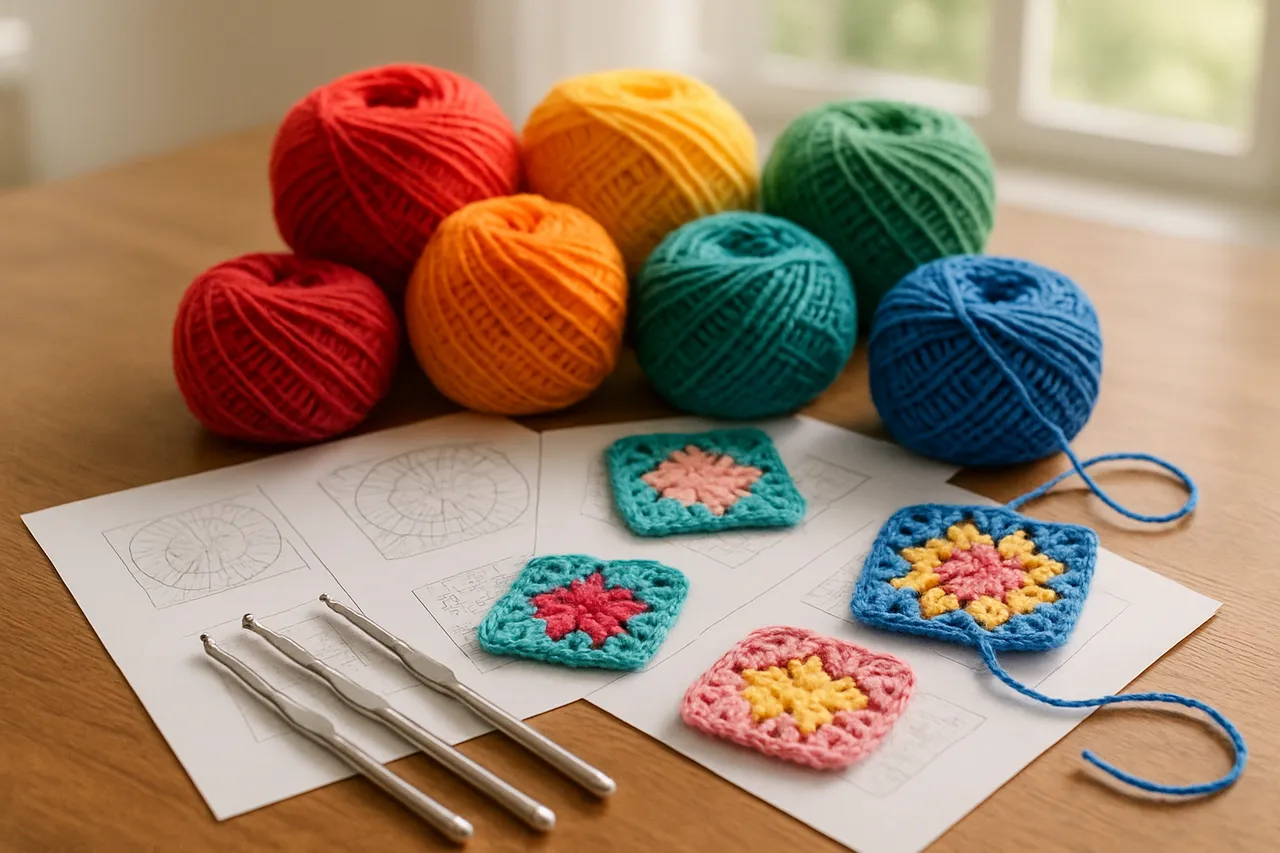
Beginner Crochet
This is crochet from absolute zero, for people who have never held a hook and think their hands are hopeless. They're not. Over six weeks we'll cover holding the hook (I'll show you two ways and let you pick), chains and single crochet, reading a written pattern, granny squares (fussy, I know), fixing mistakes without crying, and two real projects: a cotton washcloth first, then a small blanket.
Come expecting arithmetic, not spa vibes. Crochet is counting, and you'll do fine once you make peace with that. You will drop stitches and you will pull work out. That's the skill, not the failure.
You'll leave with a washcloth in your hands and a blanket started. Bring a cheap aluminum hook and a ball of cotton yarn.
What you'll learn
- Choose the right yarn, hook, and basic supplies
- Make a slip knot and work a chain
- Crochet rows evenly and turn without losing stitches
- Read written patterns and common stitch abbreviations
- Fix mistakes by frogging and picking stitches back up
Materials & tools
What to bring
- Aluminum crochet hook, size H/8 (5mm) — the class default; smooth, cheap, and easy for beginners — $2-4
- Worsted-weight (medium / #4) 100% cotton yarn, light or solid color, 1-2 balls — for the washcloth project; light colors make stitches easier to see — $3-6 per ball
- Blunt yarn/tapestry needle (large eye) — for weaving in ends and seaming — $2-4 for a pack
- Small scissors or snips — sharp enough to cut yarn cleanly — $3-6
- Flexible tape measure — for checking gauge and project size — $2-4
- A notebook and pen — for counting rows and jotting pattern notes (crochet is counting) — $2-5
Nice to have
- Set of aluminum hooks (sizes G/6 through J/10, roughly 4-6mm) — lets you try different sizes as projects change — $8-15
- Stitch markers (locking or split-ring), pack of 10-20 — mark the first/last stitch of a row so you stop losing your edges — $3-6
- Worsted-weight acrylic yarn, a few colors — cheaper practice yarn and good for the small blanket project — $3-5 per skein
- Small zip pouch or project bag — keeps hook, needle, and yarn together between classes — $5-12
Lessons
- Getting started and your first stitches
Gather your supplies and work through holding the hook, chaining, and building an even practice square.
- What you actually need to buy (and what you don't)15 min
- Two ways to hold the hook, pick one20 min
- The slip knot and your first chain20 min
- Counting chains without losing your mind15 min
- Where the hook actually goes20 min
- Turning at the end of a row15 min
- Keeping your edges straight (or: why my first scarf was a trapezoid)25 min
- Practice square, start to finish25 min
- Reading a written pattern
Decode abbreviations, follow a row of instructions, and make sense of gauge and written patterns.
- Your first washcloth, mistakes and all
Crochet a cotton washcloth start to finish and learn to spot, frog, and recover from mistakes.
- Why cotton, always, for a washcloth15 min
- Casting on and setting your width20 min
- Working the body without counting yourself into a corner25 min
- Fastening off and weaving in ends20 min
- Spotting a mistake before it's six inches down20 min
- How to frog it, and why you should20 min
- Picking the stitches back up after you rip25 min
- When to fix it and when to let it go15 min
- Granny squares and your first blanket
Work granny squares in the round, change colors cleanly, and join them into a finished blanket.
Key terms
- Chain (ch)
- The foundation row of loops you make first, which most crochet projects are built on top of.
- Slip knot
- The adjustable starting loop you put on the hook before making your first chain.
- Single crochet (sc)
- The shortest, most basic crochet stitch, worked by pulling up a loop and drawing yarn through both loops on the hook.
- Yarn over (yo)
- Wrapping the yarn around the hook, a motion used in nearly every stitch.
- Turning chain
- One or more chains made at the end of a row to bring the yarn up to the height of the next row before you turn your work.
- Gauge
- The number of stitches and rows that fit in a given measurement, used to check that your project will come out the right size.
- Granny square
- A small square motif worked in rounds from the center outward, often joined with others to build a blanket.
- Frogging
- Pulling out stitches to undo work, so named because you 'rip it, rip it' back to fix a mistake.
- Weaving in ends
- Using a tapestry needle to hide the loose yarn tails inside the finished stitches so the piece won't unravel.
- Worsted weight
- A common medium-thickness yarn (category #4) that beginners typically use with an H/8 hook.
Class discussion
- Pinned ·Introductions! Class starts May 6Marilyn Bolander · Instructor · 27 replies
- Pinned ·Week 1: Welcome, and where to parkMarilyn Bolander · Instructor · 10 replies
- Where do you get good stitch markers?Toni Stringham · 12 replies
- Finished my first crochet project 🤙Kevin Bennion · 0 replies
- Finished the crochet class - made an actual dishcloth!Steven Baxter · 3 replies
- Yarn stash questionCarly Johnson · 0 replies
Beginner Crochet: common questions
What will I learn in Beginner Crochet?
You'll start from zero: how to hold the hook, make a chain and single crochet, read a simple pattern, make granny squares, fix mistakes, and finish a first real project (a cotton washcloth, then a small blanket). No experience needed.
What supplies do I need to start crocheting?
Just three things to begin: a ball of worsted-weight cotton yarn, a size H/8 (5 mm) crochet hook, and scissors. A yarn needle for weaving in ends is handy for finishing. Aluminum hooks are perfectly fine, and nothing fancy is required.
What's the difference between crochet and knitting?
Crochet uses a single hook to pull loops through one another one stitch at a time, while knitting uses two needles to hold many live loops at once. Crochet is often easier to start because there's only one active loop to manage, and a dropped stitch is less catastrophic.
Learn more: Crochet (Wikipedia)
Is crochet hard to learn?
Most beginners are making recognizable stitches in the first class. The skill is really counting and consistency, not dexterity. Your first project will be a little uneven, and that's normal. It smooths out with a few hours of practice.
What should a beginner crochet first?
A cotton washcloth is the classic first project: it's small, forgiving, useful, and it teaches chains, single crochet, and turning rows. From there, a granny square opens the door to blankets and much more.
Learn more: Granny square (Wikipedia)
More arts & crafts classes
Beginner Watercolor Painting
with Elizabeth
Free-Motion Quilting: Finish a Lap Quilt on Your Home Machine
with Morgan
Hand Quilting Fundamentals
with Morgan