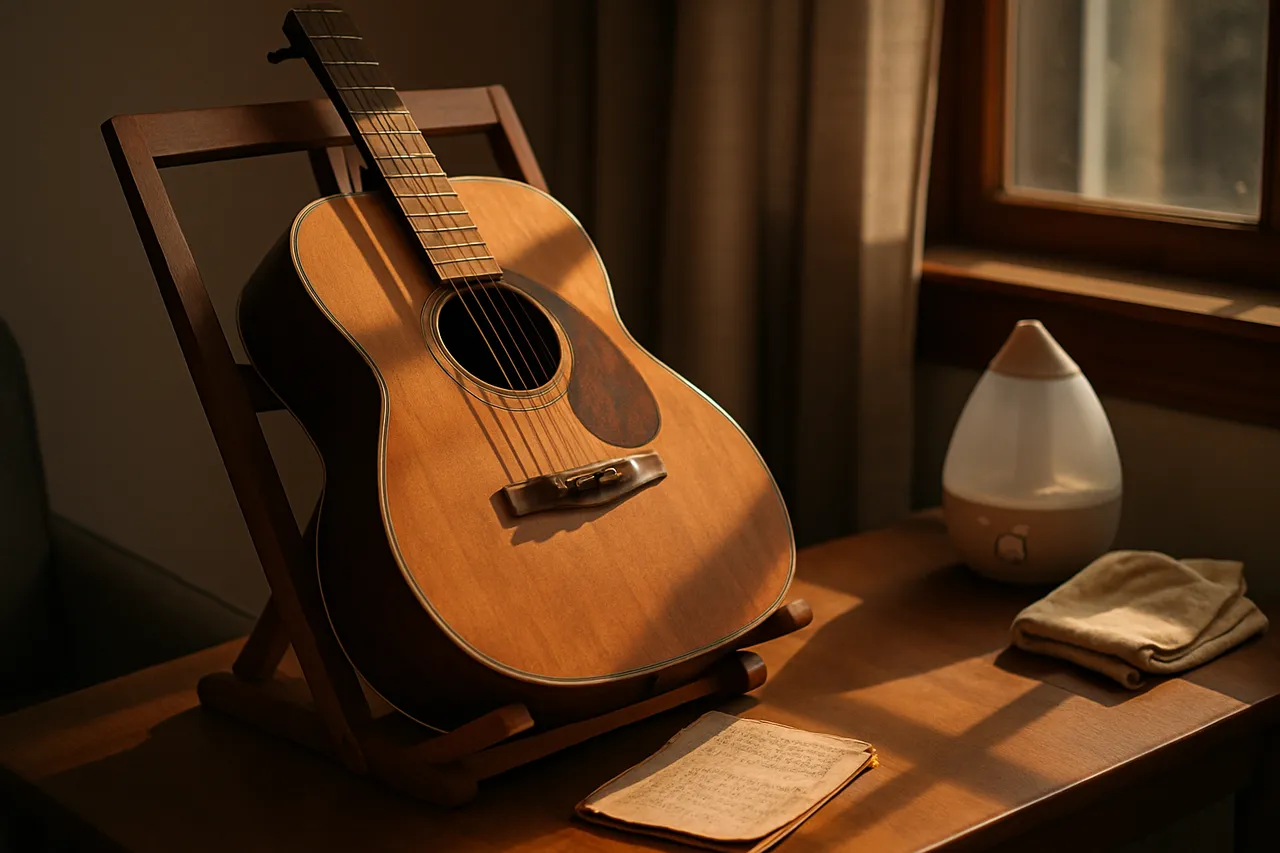
Beginner Guitar for Adults
This class is for adults who have never held a guitar, or who tried years ago and want to start over. No music reading. We'll tune, play basic open chords, change between them cleanly, and put a few strumming patterns underneath. We spend real time on caring for your instrument in our dry air, because that's the stuff that keeps a guitar playable up here.
Bring a guitar you're not scared to beat up. Every class is hands-on. I talk for a couple minutes, then it's your fingers on the strings.
You'll leave able to tune, play a handful of songs with the chords you know, and keep going on your own with a simple ten-minutes-a-day system.
What you'll learn
- Tune your guitar by ear and with a tuner
- Form Em, Am, G, C, and D chords cleanly
- Switch between chords smoothly using an anchor finger
- Strum steady down and up patterns in time
- Restring your guitar and protect it from dry air
Materials & tools
What to bring
- Acoustic guitar, full-size (steel-string dreadnought or nylon-string classical) — a used beater is perfect; $80-150 new for a starter, or borrow one
- Clip-on chromatic tuner, or a free tuner app on your phone — $10-15 for a clip-on
- Guitar picks, medium (0.60-0.73mm), a handful — they disappear; $3-6 for a dozen
- Spare set of strings in your guitar's gauge (light/.012 for acoustic) — $6-12
- Notebook and pencil for chord diagrams and your practice log — $3-5
Nice to have
- Guitar strap, so you can practice standing and it steadies the neck sitting down — $8-20
- Capo, spring-clamp style — lets you play along with more songs; $8-15
- Soundhole humidifier (Utah's dry air dries out and cracks acoustic guitars) — $10-20
- Small hygrometer to watch your case humidity, aim for 40-50% — $10-15
- Padded gig bag or hard case to protect and store the instrument — $20-60
- Footstool or a small box to raise your fretting-side leg (mainly for classical) — $15-25
Lessons
- Getting to know your guitar
Meet the instrument, learn its parts, and get it in tune (and keep it there in our dry air).
- Your hands: holding, fretting, and picking
Settle your posture and both hands so every string rings clean, calluses and all.
- Your first chords and changing between them
Learn Em, Am, G, C, and D, clean them up, and move between them in time.
- Em and Am: the easy way in20 min
- G and C: the two you'll use forever22 min
- D and reading a chord diagram20 min
- Checking your chords: what's buzzing and why18 min
- Slow changes and the one-finger anchor trick20 min
- Em to G to C to D, over and over22 min
- Counting beats so changes land on time18 min
- When it sounds like a dying appliance (it's normal)15 min
- Strumming, songs, and keeping it going
Add strum patterns to play a full song, then care for the guitar and build a daily habit.
- Down strums and keeping steady time18 min
- Adding upstrums without falling apart20 min
- Two or three patterns that fit most songs22 min
- Playing a full song, chords and strum together25 min
- Humidifying your guitar in Utah County18 min
- Restringing, hands-on, no blurry video25 min
- The ten-minutes-a-day system that actually works15 min
- Where to go next and what to ignore15 min
Key terms
- Fret
- One of the metal strips running across the neck; pressing a string down just behind a fret shortens it to sound a specific note.
- Fretboard (fingerboard)
- The flat front surface of the neck where you press the strings to form notes and chords.
- Open chord
- A basic chord played near the top of the neck that lets one or more strings ring open (unfretted), such as G, C, D, E minor, or A minor.
- Standard tuning
- The default pitches of the six strings from thickest to thinnest — E, A, D, G, B, E — that most beginner songs assume.
- Chord change (transition)
- Moving your fingers from one chord shape to another cleanly and in time, which is the main skill a beginner is building.
- Strumming pattern
- A repeating sequence of downstrokes and upstrokes that sets the rhythm underneath the chords you're holding.
- Capo
- A clamp placed across all the strings at a chosen fret that raises the guitar's pitch so you can play familiar chord shapes in a different key.
- String gauge
- The thickness of the strings; lighter gauges are easier on beginner fingertips, while heavier ones are louder and stiffer.
- Action
- The height of the strings above the fretboard; lower action is easier to press down, while very high action makes a guitar tiring to play.
- Barre chord
- A chord in which one finger presses down several strings at once across a fret, letting you move a single shape up and down the neck.
Class discussion
- Pinned ·welcome - class starts May 4, say hi belowChance Sorensen · Instructor · 14 replies
- finally got a clean chord change last nightAaron Larsen · 1 replies
- Question about that last chord change we learnedKristy Jorgensen · 5 replies
- Anyone else's strumming hand just freeze up?Kenneth N. · 1 replies
More music & performing arts classes
Community Choir
with Blake

Guitar Skills Beyond the Basics
with Chance

Intro to Acting
with Anne