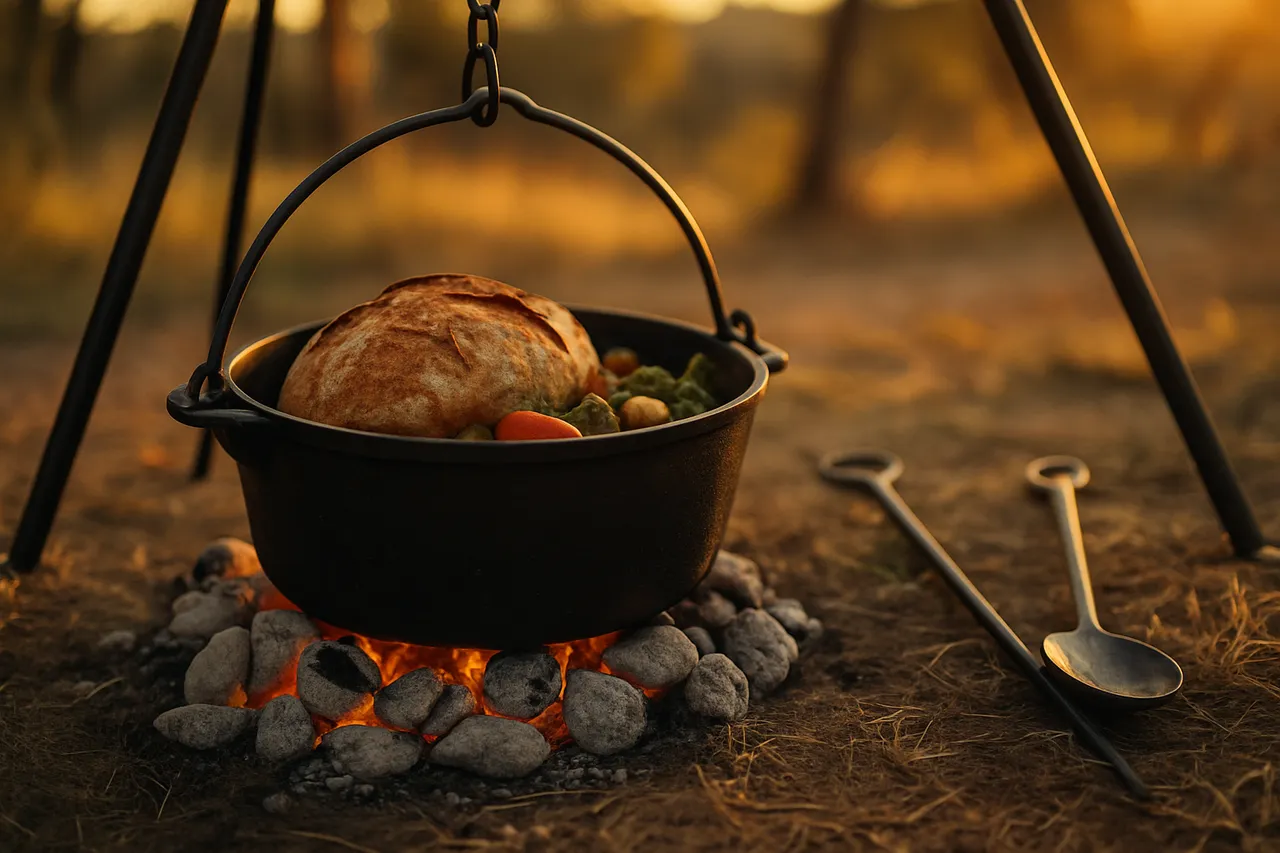
Dutch Oven Camp Cooking Basics
Okay so the goal here is simple: cook a full meal outdoors on charcoal and cast iron, and have it come out better than granola bars. This class is for families and new campers who didn't grow up doing this. You don't need any experience. You'll learn heat control (charcoal briquettes, counted, no guessing), how to season an oven so it lasts, and the cleanup that actually keeps it rust-free in our dry-then-humid weather.
We cook every week, hands-on. By the end you'll have made a full chicken-and-potatoes style dinner plus a cobbler, and you'll know how to clean up so your oven doesn't rust on the counter overnight. That last part matters more than people think.
What you'll learn
- Identify and inspect a used camp Dutch oven
- Season and re-season a rusty cast iron find
- Count and arrange charcoal for baking or roasting
- Cook a complete one-pot chicken and potato meal
- Clean, dry, and store your oven to prevent rust
Materials & tools
What to bring
- Camp Dutch oven, 12-inch / 6-quart, cast iron with legs and a flanged lid — the standard family size; new pre-seasoned $40-70, or bring one you already own
- Charcoal briquettes, one standard bag (about 15 lb) — plain briquettes, not instant-light or match-light; $8-12
- Chimney starter for lighting coals cleanly without lighter fluid — $15-25
- Long-handled lid lifter or heavy pliers to move the hot lid without dumping the coals — $12-20
- Heat-resistant gloves (welding or leather work gloves) — $12-25
- Long metal tongs for placing and arranging individual coals — $8-15
- Trivet or lid stand to set the hot lid on while you check food — $8-15
- Notebook and pen for counting coals and timing (this class teaches counting, not guessing) — $2-5
- Paper towels and a small bottle of cooking oil for cleanup and re-seasoning on the spot — $5-8
Nice to have
- Fireproof mat, sheet pan, or old cookie sheet to set the oven on and catch ash — $10-20
- Ash bucket or metal pail with a lid for safely disposing of spent coals — $10-20
- Whisk broom or ash brush to sweep coals off the lid before opening — $5-10
- Stiff plastic scraper or chainmail scrubber for cleaning stuck-on food without soap-heavy washing — $8-15
Lessons
- Choosing and gathering your gear
What a camp Dutch oven is, buying one used, and the rest of the kit you need.
- Seasoning and getting the oven ready
Understanding seasoning, reviving a rusty find, and knowing when it's ready to cook.
- Managing coals and heat
Lighting coals, counting them top and bottom, and controlling your heat in the wind.
- Cooking your first meals
Planning and cooking one-pot dinners, sides, and even a cobbler.
- Planning a one-pot meal that works15 min
- Chicken and potatoes: the driveway dinner25 min
- A side that won't turn into charcoal20 min
- Checking doneness without wrecking your heat15 min
- Cobbler: the one everybody wants25 min
- Why my first cobbler failed and what fixed it15 min
- Dutch oven rolls, if you're feeling brave20 min
- Cleaning, storage, and safety
Cleaning without stripping the seasoning, storing it rust-free, and handling coals safely.
Key terms
- Camp Dutch oven
- A heavy cast-iron cooking pot with three short legs and a flat, rimmed lid, designed so charcoal can sit both underneath and on top for all-around heat.
- Briquette
- A uniform compressed lump of charcoal that burns at a fairly predictable rate, making it the standard heat source for controllable Dutch oven cooking.
- Seasoning
- The hardened layer of baked-on oil that gives cast iron its natural non-stick surface and protects it from rust; it builds up the more you cook and re-oil.
- Chimney starter
- A metal cylinder that lights a batch of briquettes evenly using only newspaper or a fire starter, with no lighter fluid or chemical taste.
- Coal count
- The practice of using a set number of briquettes on top and bottom to reach a target temperature, rather than eyeballing the fire.
- The doubling rule
- A common guideline that the diameter of the oven in inches, times two, gives the total number of briquettes for roughly 325 F baking heat.
- Lid lifter
- A long-handled hook or bar used to raise the hot, coal-covered lid straight up without spilling ash into the food.
- Flanged lid
- A lid with a raised outer rim that keeps hot coals from sliding off the top and can be flipped over to use as a griddle.
- Hot spot
- An area of the pot that runs hotter than the rest, usually from uneven coals or wind, which is why cooks rotate the oven and lid during cooking.
- Rotating the oven
- Turning the pot and its lid a quarter-turn in opposite directions every 10-15 minutes so food cooks and browns evenly instead of scorching on one side.
Class discussion
- Pinned ·Welcome to Dutch Oven Camp Cooking Basics - class starts May 7Kelli Stewart · Instructor · 7 replies
- Pinned ·Week 1: Welcome, and the number that mattersKelli Stewart · Instructor · 5 replies
- Braise week, texture pollKelli Stewart · Instructor · 6 replies
- 12 inch dutch oven, where'd everyone get theirsBrandon Wettstein · 0 replies
- dutch oven class wrap upKaden · 0 replies
- Final cook, what are you makingKelli Stewart · Instructor · 4 replies
More outdoors & recreation classes
Beginner Fly Fishing on Utah Rivers
with Gilbert
Fly Tying for Utah Trout Streams
with Gilbert
Hiking the Wasatch: Trail Planning and Fitness
with Kelli