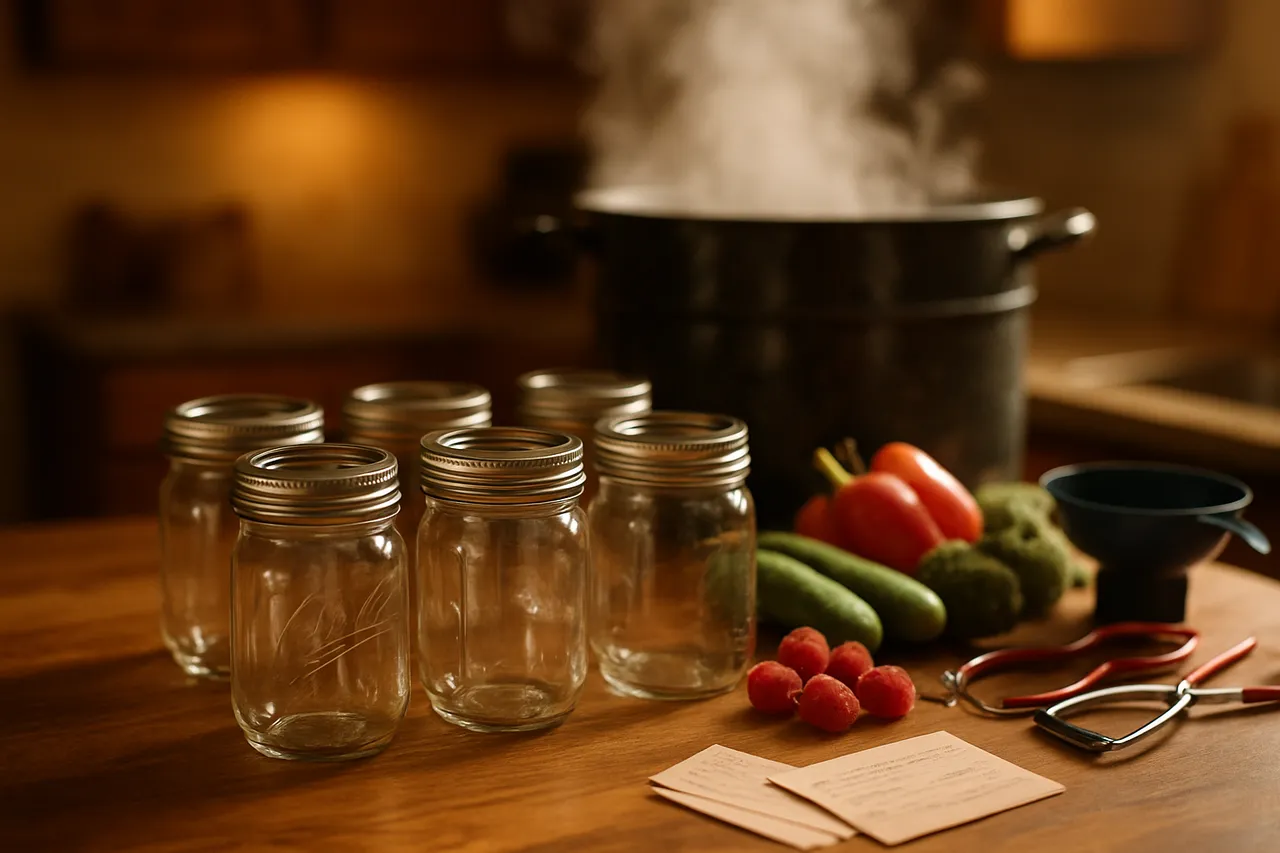
Water Bath Canning for Beginners
If botulism is the reason you've never canned, this class is for you. Water bath canning is for high-acid stuff like jam and pickles, and once you know the acid rules, you're fine. I promise you can relax about it. We meet Tuesday mornings and we actually make things, no watching me lecture. You'll can a batch of peach jam and a batch of pickles start to finish, and you'll leave knowing how to check a seal, what a good seal even sounds like, and how to store your jars so they keep. This is for total beginners. If you've never touched a canner in your life, come. Bring nobody's fear but your own, and we'll fix that too.
What you'll learn
- Distinguish safe water bath foods from pressure canning needs
- Select proper jars, lids, and canning equipment
- Prepare and pack fruit and pickle recipes correctly
- Process jars at the right time for your altitude
- Check seals and store finished jars safely
Materials & tools
What to bring - Water bath canner or a tall stockpot with a rack/canning insert — pot must be deep enough for 1-2 in. of water over jar tops ($25-45; a large stockpot you own works if it's deep enough) - Canning rack that fits your pot (keeps jars off the bottom) — $8-15 - Regular-mouth glass canning jars (Ball or Kerr), pint and half-pint sizes for jam and pickles — $10-14 per dozen - New two-piece lids and bands (lids are single-use; bands reuse) — $3-8 per box; buy extra flat lids - Jar lifter (rubberized tongs for hoisting hot jars) — $6-10 - Canning funnel (wide-mouth, keeps rims clean) — $4-8 - Bubble remover / headspace tool (a plastic chopstick works too) — $3-6 - Clean kitchen towels and a folded towel or cooling rack to set hot jars on - Ladle and a heat-safe measuring cup - Timer (phone is fine) - A produce for practice: ripe peaches for jam and cucumbers for pickles (instructor may supply; ~$10-15 if bringing your own)
Nice to have - Kitchen scale for weighing fruit and sugar — $12-20 - Bottled lemon juice or citric acid for acidifying (never fresh-squeezed for canning) — $2-4 - Fine-mesh strainer or jelly bag for smoother jam — $6-12 - Magnetic lid lifter — $3-5 - Permanent marker and labels for dating jars
Lessons
- How water bath canning stays safe
The core idea behind the method, the acid rule, and what this class deliberately leaves to pressure canning.
- The pot, the jars, and the tools
What actually counts as a canner, which jars and lids to trust, and which little gadgets are worth buying.
- Getting your jars and workspace ready
Whether you really need to sterilize and how to lay everything out before the heat goes on.
- Making and jarring peach jam
Your first project start to finish: picking and prepping fruit, pectin, cooking the jam, and filling jars right.
- Putting up a batch of pickles
A savory, high-acid project with salted cucumbers, the vinegar brine, and packing jars so they hold.
- Processing jars in the canner
Loading jars cleanly, bringing the water to a boil, and adjusting processing times for our altitude.
- Cooling jars and checking the seals
Letting jars rest and tink, testing every seal, and knowing where and how long they keep.
- Labeling, troubleshooting, and going solo
Marking your jars, spotting one that failed or went bad, and running your first batch on your own.
Key terms
- Water bath canning
- A preservation method where filled, sealed jars are fully submerged in boiling water to heat-process high-acid foods like jams, fruit, and pickles.
- High-acid food
- A food with a pH of 4.6 or lower (most fruits, pickled items, and acidified tomatoes) that is safe to process in a water bath because acidity blocks dangerous bacteria.
- Headspace
- The empty gap left between the top of the food and the jar rim, needed so the lid can form a proper vacuum seal during processing.
- Vacuum seal
- The airtight closure that forms as a processed jar cools and its lid is pulled down tight, keeping air and microbes out during storage.
- Botulism
- A rare but serious illness caused by toxin from Clostridium botulinum bacteria, which is why low-acid foods must never be water bath canned.
- Hot pack
- Filling jars with food that has first been heated to boiling, which helps remove air and improves color and seal reliability.
- Raw pack
- Filling jars with raw, unheated prepared food before adding hot liquid and processing, a faster method used for certain fruits.
- Processing time
- The number of minutes jars must stay in actively boiling water, set by a tested recipe and adjusted upward for altitude.
- Altitude adjustment
- Adding processing time (or pressure) at higher elevations because water boils below 212 degrees F, so heat penetrates food less effectively.
- Siphoning
- The loss of liquid from jars during or after processing, usually caused by overfilling, rapid temperature swings, or removing jars too soon.
Class discussion
- Pinned ·welcome! class starts May 5 (say hi + why you're here)Toni Carr · Instructor · 13 replies
- Pinned ·Welcome, and let's talk lids and rings before TuesdayToni Carr · Instructor · 8 replies
- canned my first batch after the class endedKelton Martinez · 0 replies
- How many jars are you each bringing homeToni Carr · Instructor · 5 replies
- Pickles vs jam, which do you like better so farToni Carr · Instructor · 2 replies
- my pickles actually crunchedMelissa Hahn · 0 replies
More cooking & baking classes
Artisan Pizza Dough and Toppings
with William
Beyond Weeknight Italian: Sauces, Braises, and Fresh Pasta
with Devin
Bulgogi & Beyond: Korean Home Cooking
with Caroline