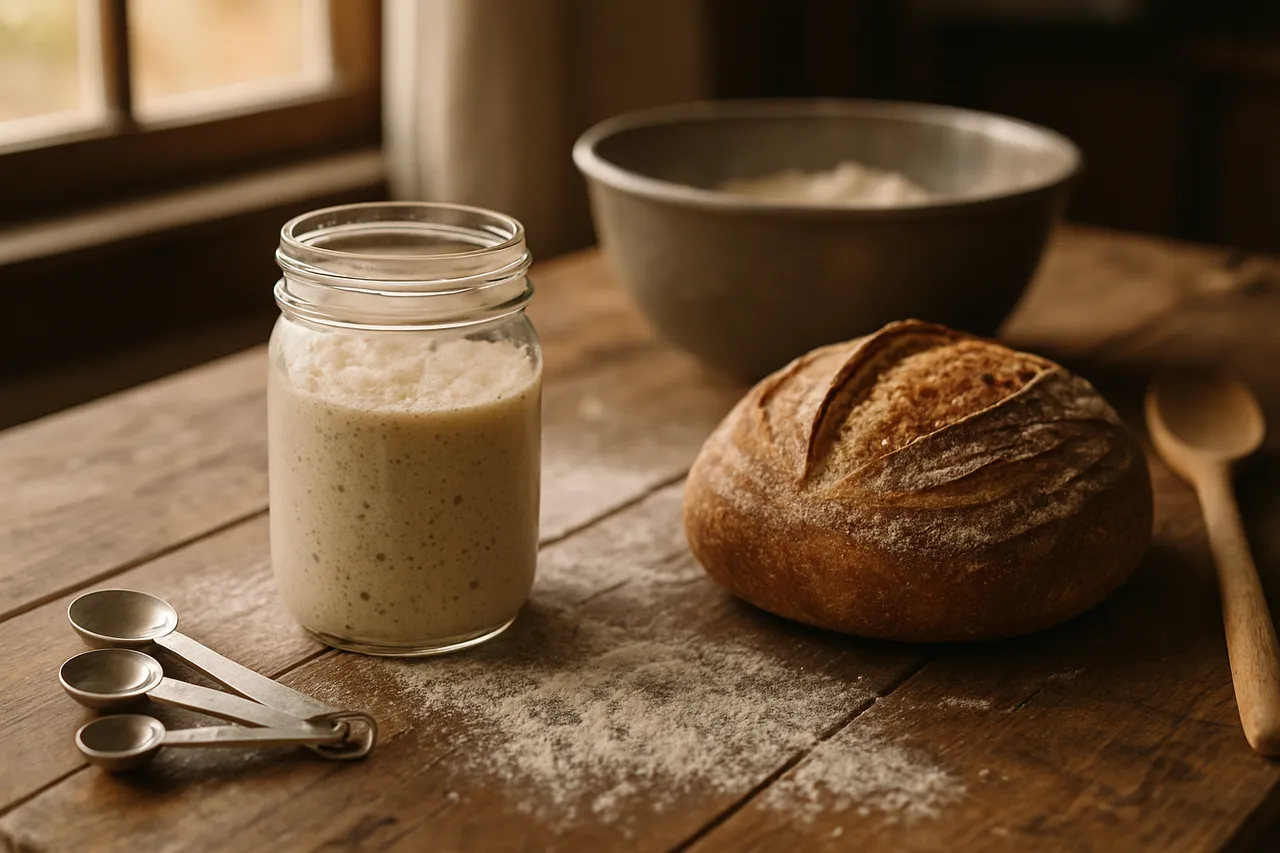
Sourdough Bread from Scratch
People treat sourdough like some mystic art, but it comes down to flour, water, salt, and time — and it's still harder than it sounds, in a way I've come to like.
This class is for anyone who has never kept a starter alive and wants a loaf they can make again next week and the week after. We'll build a starter from scratch, feed it on a schedule you'll actually keep, then mix, shape, and bake a basic sourdough. Everything's in grams. Bring a notebook.
We bake for our air, not a coastal blogger's. At about 4,600 feet with this dry weather, timelines lie, so I'll teach you to read the dough instead of the clock. You'll leave with a repeatable recipe and a starter that's yours.
What you'll learn
- Build and maintain a healthy sourdough starter
- Calculate hydration using baker's percentages
- Read dough during bulk ferment instead of the clock
- Shape, score, and bake with a Dutch oven
- Troubleshoot gummy, dense, or flat loaves
Materials & tools
What to bring
- Notebook and pen — for logging feed times, temps, and how the dough behaves ($2-5)
- Digital kitchen scale that reads in grams, ideally to 1g — everything in this class is weighed, not measured in cups ($12-25)
- Bread flour, unbleached, at least 2-3 lbs (King Arthur or similar) — higher protein than all-purpose for a stronger rise ($4-6)
- Whole wheat or rye flour, a small bag — used to get the starter going ($4-6)
- Two clear straight-sided jars or containers, ~16 oz each, with loose lids — one for the starter, one for feeding ($8-15)
- Large mixing bowl, at least 4-quart, plus a bench/dough scraper ($8-15)
- Rubber band or dry-erase marker — to mark starter level and track its rise ($1-3)
Nice to have
- Banneton or proofing basket, 8-9 inch round, with a liner (a bowl lined with a floured towel also works) ($12-18)
- Dutch oven, 5-6 quart, enameled or bare cast iron — traps steam for good oven spring ($40-80)
- Bread lame or a fresh razor blade — for scoring the loaf before baking ($8-12)
- Instant-read thermometer — to confirm the loaf hits ~205-210°F inside ($10-20)
- Parchment paper — makes transferring dough into a hot Dutch oven much easier ($3-5)
Lessons
- Gear and the numbers behind bread
The short list of tools that matter, why a scale beats cups, and how to read flour, salt, water, and baker's percentages.
- Starting a starter from scratch
Mixing flour and water on day one and nursing it through the first week until it's alive and ready to bake with.
- Keeping your starter alive
Feeding schedules, counter versus fridge storage, using up discard, and reviving a starter you forgot about.
- Mixing and bulk fermentation
The first mix and autolyse, adjusting hydration for our dry air, stretch and folds, and reading the dough through bulk rise.
- Shaping and the overnight proof
Pre-shaping, final shaping into a tight round, choosing a vessel, and the cold proof that fits your schedule.
- Scoring and baking day
One clean slash for oven spring and baking in a Dutch oven or an improvised setup.
- Judging the loaf and fixing what went wrong
Reading crust and crumb to know when it's done, then troubleshooting gummy, dense, or flat results.
Key terms
- Starter (levain)
- A living culture of flour and water colonized by wild yeast and bacteria that leavens the bread instead of commercial yeast.
- Feeding (refreshing)
- Discarding part of the starter and stirring in fresh flour and water to keep the yeast active and healthy.
- Hydration
- The weight of water expressed as a percentage of the flour weight; higher hydration means a wetter, stickier dough.
- Autolyse
- A rest period where flour and water are mixed and left alone before adding salt, letting gluten begin forming on its own.
- Bulk fermentation
- The first long rise after mixing, when the whole batch of dough ferments and develops flavor and structure.
- Stretch and fold
- A gentle technique of pulling the dough up and folding it over itself during bulk fermentation to build strength without kneading.
- Shaping and proofing
- Forming the dough into its final loaf shape, then letting it rise a second time before baking.
- Oven spring
- The rapid rise a loaf gets in the first minutes of baking as trapped gases expand from the heat.
- Scoring
- Slashing the top of the loaf with a blade just before baking so it expands in a controlled way instead of tearing.
- Crumb
- The interior texture of the baked bread, described by the size and openness of its holes.
Class discussion
- Pinned ·Welcome! Class starts May 4 - come say hiSharon Atkinson · Instructor · 6 replies
- forgot to feed my starter for 3 days after class ended, anyone else slacking already?Paul T. · 2 replies
- starter is sluggish since class, helpMathew · 8 replies
- stretchy dough tip from bulk ferment weekBrenden Johnson · 0 replies
- Dough scraper recommendation?Wayne F. · 0 replies
More cooking & baking classes
Artisan Pizza Dough and Toppings
with William
Beyond Weeknight Italian: Sauces, Braises, and Fresh Pasta
with Devin
Bulgogi & Beyond: Korean Home Cooking
with Caroline